When Architecture Dies
2025 / EN, essays, textsThe Curious Case of Brindisi
I was born in Mesagne, like most children of the Nineties. For reasons that still escape me, the local municipal hospital enjoyed a certain reputation throughout the Brindisi area, to the point that many families in the region seemed to prefer it. And yet my family has always been from Brindisi — a city that has traversed epochs, foreign dominations, earthquakes and rebirths, managing the paradoxical feat of preserving almost nothing of its own architectural history.
My time in Brindisi was never long. I lived there only during my secondary school years. The rest of my life has been one continuous displacement — an enrichment, certainly, but also a form of uprooting: an education in statelessness. And yet every return has been an occasion to rediscover its spaces with a gaze that is simultaneously foreign and familiar. The streets of the old centre, walked with my parents and grandparents, reveal a fragmentary urban fabric, as if the entire city were the result of a work left unfinished.
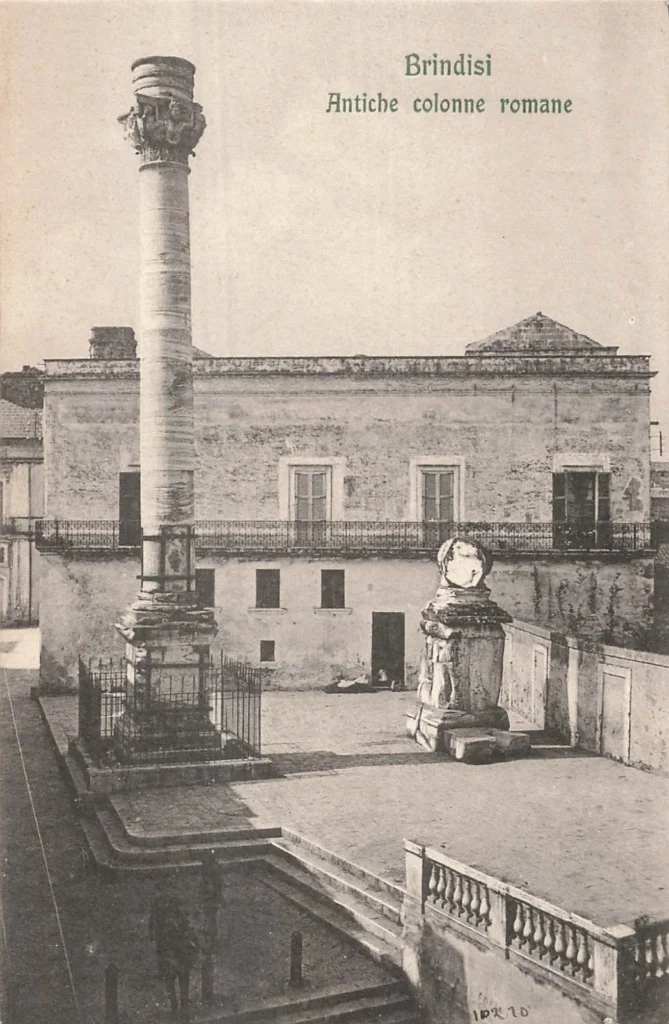
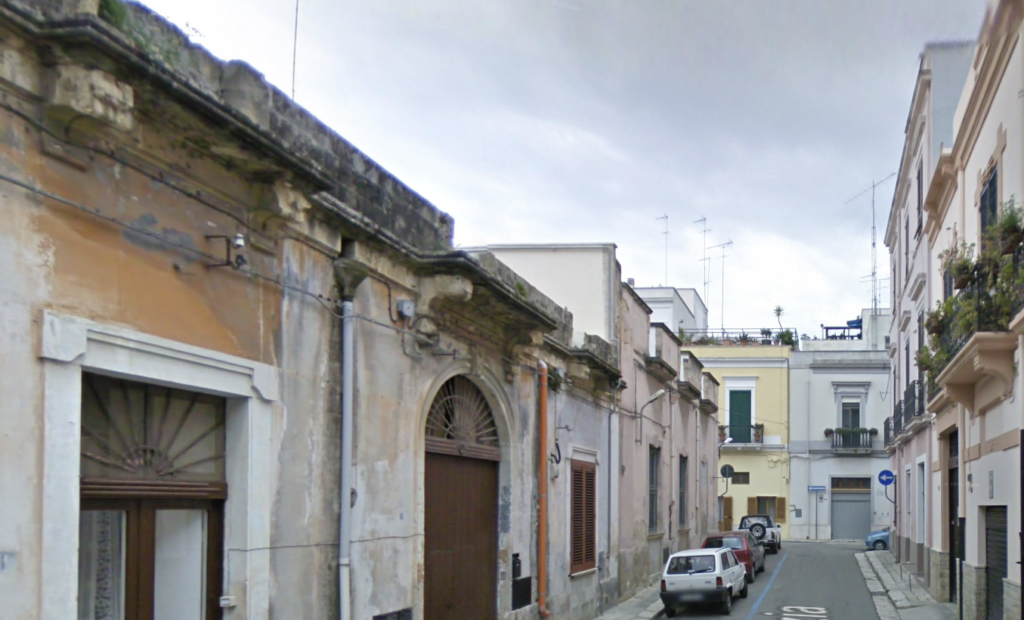
Many houses in the historic centre seem built to grow, but never will. The upper storey is barely sketched, stops at half-height: truncated walls that open without warning onto solitary balconies, almost diving boards over the void, distributed along façades that appear provisional. It is an incomplete city, or better: a perpetually interrupted one.
I. The Root of Evil
The urban history of Brindisi is that of a city constantly struck down and each time rebuilt — but always halfway. Every trauma, every new beginning seems to entail an irreversible loss: of form, of meaning, of memory. There is something like a curse of architectural oblivion that weighs upon the city. It is natural to lose something when traumatic events strike an urban fabric. But is it equally natural to forget?
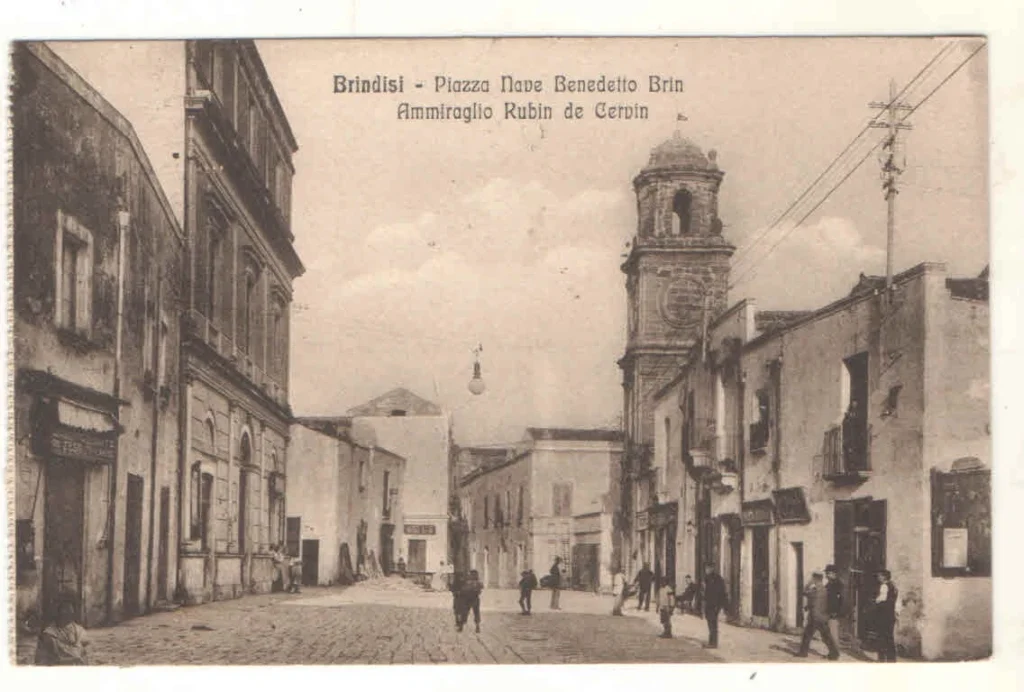
The case of the eighteenth-century clock tower is, in this sense, exemplary — and not for the demolition itself. The tower was pulled down in 1956 to make way for the ultra-modern INPS building: one of many victims of that low-quality “modernism” that accompanied Brindisi’s aspiration to become a provincial capital, an era in which progress seemed to require the removal of memory rather than its reinterpretation. So far, a story common to many Italian cities of the postwar period. What makes the Brindisi case peculiar is what happened next: in 2005, forty-nine years after the demolition, a bronze plaque was placed at the exact spot where the tower had stood, to commemorate its disappearance. A city that erects a funeral monument to what it itself destroyed half a century earlier is not celebrating memory — it is exhibiting remorse as a substitute for design. The plaque reconstructs nothing, proposes nothing, repairs nothing. It merely certifies that the loss has been registered, archived, and thereby dismissed.
And yet those same postwar years had witnessed, elsewhere, radically different experiences. Carlo Scarpa’s restoration of Castelvecchio in Verona, carried out between 1957 and 1964, did not mourn the past or mimic it: it interrogated it. Every design decision — the cut through the medieval masonry, the suspension of the statue of Cangrande, the metal detail that visibly separates old from new — was a critical act, a declaration of contemporary presence that made no apology for existing. Similarly, Franco Albini at Palazzo Bianco in Genoa constructed an exhibition system that made its own status as intervention visible, without pretending to be something it was not. In both cases, the modern did not impose itself on the past: it measured itself against it, acknowledging its value and building new meanings in the dialogue between times. Modernity, in other words, did not lack the instruments to be a project of continuity as well. But those instruments, in Brindisi, were never sought. Or worse: they were never considered necessary, because the problem was not technical. It was one of identity.
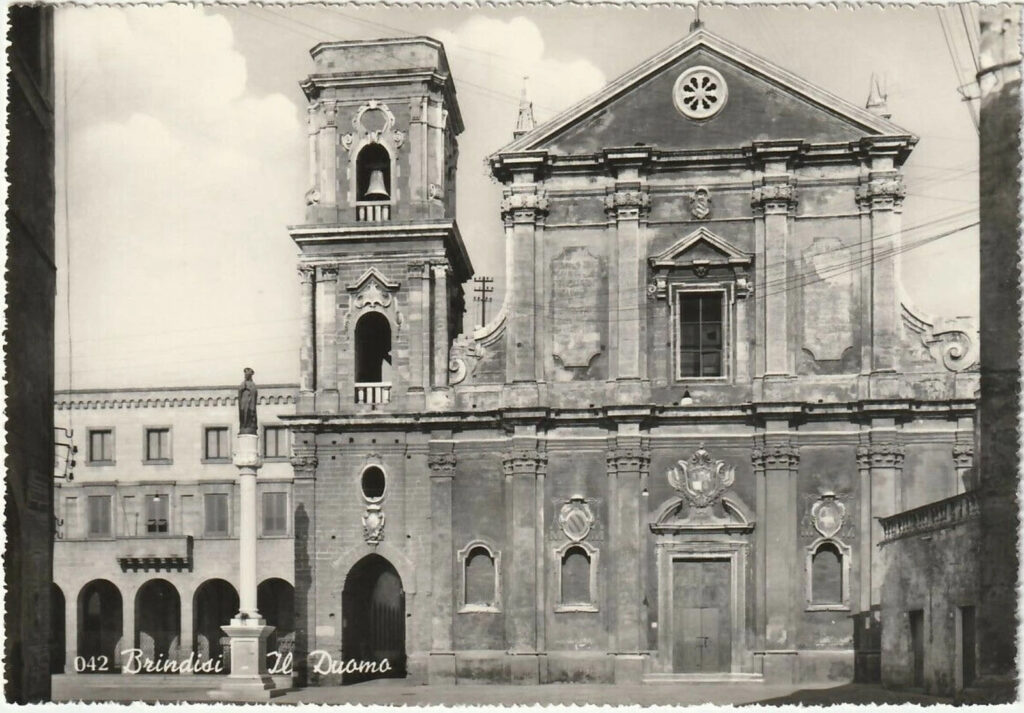
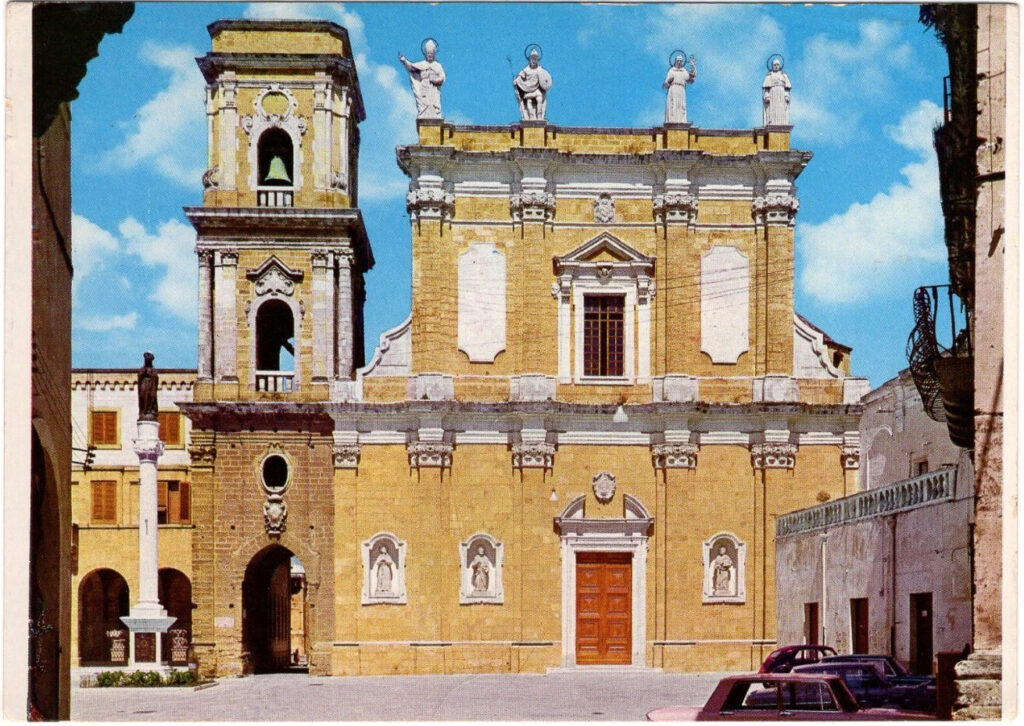
The problem seems endemic, almost genetic. A telling case is the Cathedral. After the terrible earthquake of 1743, the reconstruction was entrusted to Mauro Manieri, a celebrated architect from Lecce. And yet that baroque façade was always regarded with suspicion by the people of Brindisi, judged a “cold and weary replica.” This identity insecurity explodes in the twentieth century. It is 1921 when Archbishop Tommaso Valeri, in a letter to the Soprintendenza justifying certain internal demolitions, writes a sentence that reads like a death sentence:
“It is well known that the Cathedral of Brindisi unfortunately has no interest whatsoever, neither historical nor artistic.”
There it is — the root of the problem: self-contempt. If the guardian does not love the temple, who will save it?
It was in this climate of devaluation that, in 1923, the construction of a pastiche tympanum with a small rose window was approved. Not a restoration, but a stage trick: a historical fake was added to “ennoble” a baroque façade of which the city was ashamed. Then came the war, and with it the subsequent purist fury of the postwar years. The tympanum of 1923 was removed, the timber roof replaced with reinforced concrete, all in the name of a supposed stylistic purity. If one compares photographs of the cathedral with the tympanum from the 1920s and its current appearance, one witnesses the chronicle of a genuine schizophrenia: first, false elements are added because one hates what one is — Manieri’s “cold” baroque — then everything is stripped away in pursuit of a medieval purity that no longer exists. The result is a Cathedral that has become opaque. Light, which in architectural liturgy is a theological element, has been reduced to functional illumination.
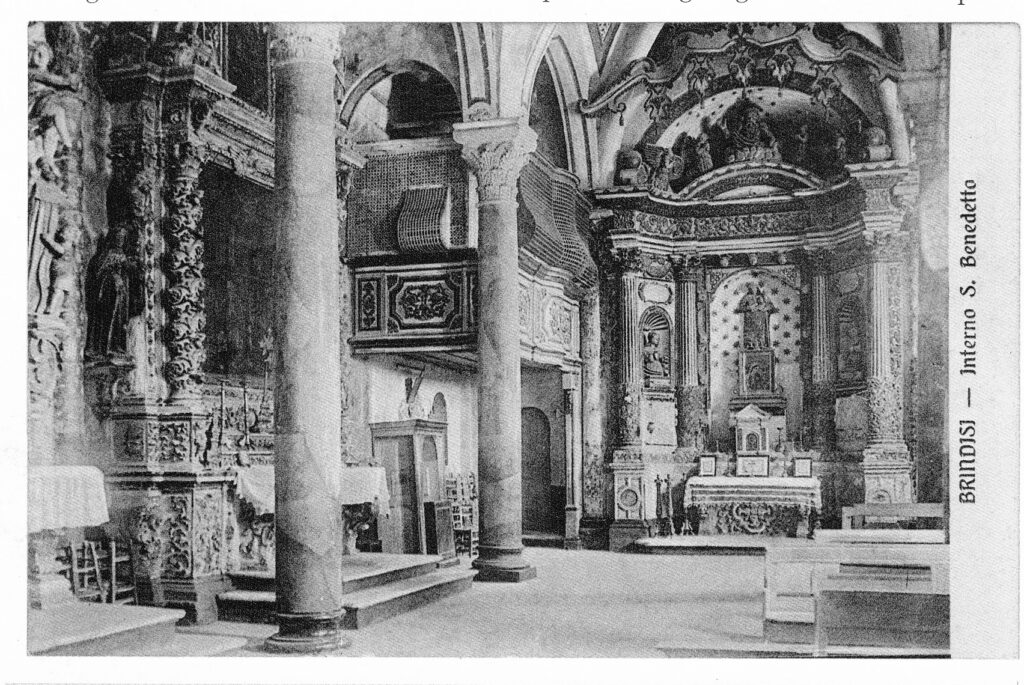
The same fate befell San Benedetto. After the 1920s, altars, wooden choir stalls and decorative apparatuses disappeared. The compositional unity was dissolved. By the 1950s the process was complete, leaving a church that had been martyred — or, more precisely, restored according to no recognisable architectural criterion.
Let it be understood: every historic building is the product of stratifications, reworkings, additions. This is the very lesson of critical restoration theory, from Camillo Boito to Giovanni Carbonara: the identity of an architectural artefact is forged over time, through the secular collaboration of different minds and hands. Architecture, the real kind, belongs to no single author and no single moment. But here transformation has ceased to be care and has become erosion. The cathedral appears as the result of a sum of subtractions. Every intervention seems to have taken something away: taste, memory, the capacity for dialogue with history. The few surviving fragments of the original mosaic decoration are today visible only behind a clouded pane of glass, like poorly kept relics.
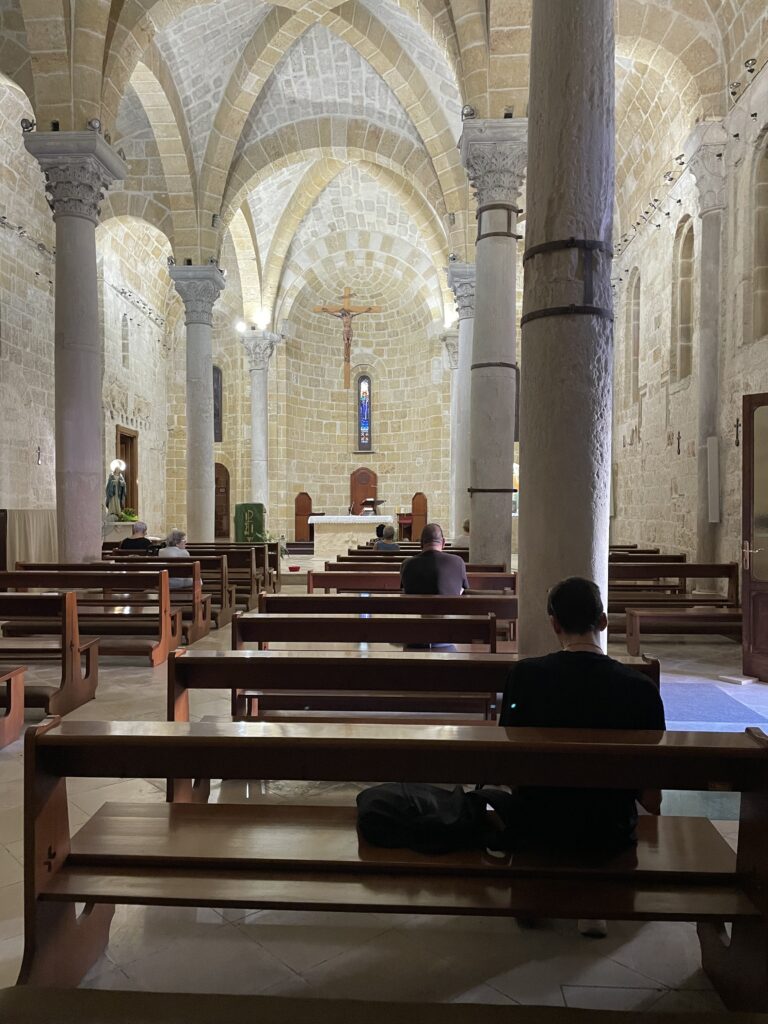
And yet Brindisi was — and remains — one of the oldest episcopal sees in southern Italy. The cathedral stands on an early Christian basilica dating to at least the fifth century; in the Norman period, between the eleventh and twelfth centuries, it acquired a Romanesque layout akin to that of the great Apulian cathedrals: apses, transept, triapsidal plan. Of all this, only fragments remain, visible from the outside, embedded in walls that seem to want to ignore them. One cannot help but ask: if Brindisi was truly one of the eastern gateways of the Roman world, where are the traces of that past today? Has everything become dust, embedded in the lime mortar of some wall? Or, more unsettling still, was what we uncovered in our attempts to bring the past to light so little seductive as to lead us to replace it?
II. Constructed Amnesia
Between hyperconservative heritage bodies and museifying restorations, today we tend to treat every stone as sacred, in the name of “memory for future generations.” But in doing so we forget that architecture is, first of all, the intentional construction of the present. And what we build today — often without design or responsibility — is a collage of dissociated fragments, incapable of generating meaning, space or shared memory.
When one does not intervene to bring miraculous pasts to light — as has happened with the church of San Paolo, today reduced to a shed punctuated with baroque altars — one nonetheless tends to operate upon a frozen status quo, privileging a supposed historical memory of the monument at the expense of its architectural coherence and spatial quality, sacrificing the possibility of producing new value. The dominant approach today is no less problematic than the postwar purist one: where the latter removed in the name of an ideal original purity, the former conserves in the name of an ideal documentary completeness. Both share the same inability to inhabit the present tense.
The result is that architecture disappears, replaced by inert fragments that design incompetence has rendered incapable of dialogue. One no longer creates a space endowed with meaning; one accumulates traces — a blind chronology, a formless palimpsest, legible perhaps by specialists, but indifferent to those qualities that, since Roman antiquity, have defined architecture as such: utilitas, firmitas, venustas.
When we look at historical photographs of San Benedetto and ask ourselves whether it was not more beautiful then than now, are we perhaps celebrating the past with the same fanaticism of those who destroyed the present? Or are we rather recognising a design unity — built over time according to coherent principles — that has today been dismembered in favour of an incomplete draft, devoid of architectural sense?
This is, perhaps, the silent illness of architecture in Brindisi: not so much abandonment, as the systematic substitution of memory with the formless. A constructed amnesia, which confronts us with a crucial question: what survives of a city when it is no longer wars or centuries that destroy its memory, but the decisions of its own citizens?
III. The Unfinished as Condition
The answer, perhaps, lies in a radical shift of paradigm: ceasing to regard Brindisi as a terminal patient to be kept artificially alive through conservative restoration, and beginning to see it for what it really is — an unfinished work.
That incompleteness I sensed as a boy is not only a lack: it is room to manoeuvre. It is there, between the truncated walls and the gutted squares, that contemporary architecture can and must insert itself. Not to blend in or to apologise, but to complete an interrupted conversation. Brindisi does not need more guardians of ashes; it needs architects who have the courage to add their own layer to the palimpsest, accepting the risk that every vital act entails.
Nostalgia for a lost origin, if unaccompanied by an intentional act of transformation, becomes a paralysing device. In the attempt to save everything, one ends up designing nothing. Memory becomes an alibi.
And so the final question is this: why are we today perfectly capable of looking at an eighteenth-century work with a critical, historical, even ruthless eye, yet would never dare to transform it — by any approach, in any language — whereas less than eighty years ago this was still considered possible, if not necessary? Why do we regard any act of formal reconstitution, even when declared, argued and self-aware, as a historical forgery rather than a continuation of the work through time?
No historic architecture we venerate today has reached us intact, immune from transformations, compromises or reinterpretations. The difference is that those transformations were expressions of design intention, whereas today the fear of getting it wrong has replaced the courage to intervene. It is not the historical fake we fear, but the risk of design itself. And in this slippage, architecture retreats once more, yielding to a memory that no longer builds anything.
Architecture dies when it becomes only preservation. It is reborn when it becomes design again.
Marginal note. The question of critical restoration — from Boito to Carbonara, from Scarpa to Albini — is not a technical question but an epistemological one: it concerns what we believe we must transmit, and to whom. A building restored philologically but spatially dead does not transmit architecture: it transmits documentation. There is a difference, and it is not a small one. Perhaps the deepest problem of Brindisi is not that it destroyed too much, but that, in its belated attempt to conserve, it forgot why it used to build.